
About Me
Doctoral Supervisor: Dangxiao Wang
Achievements
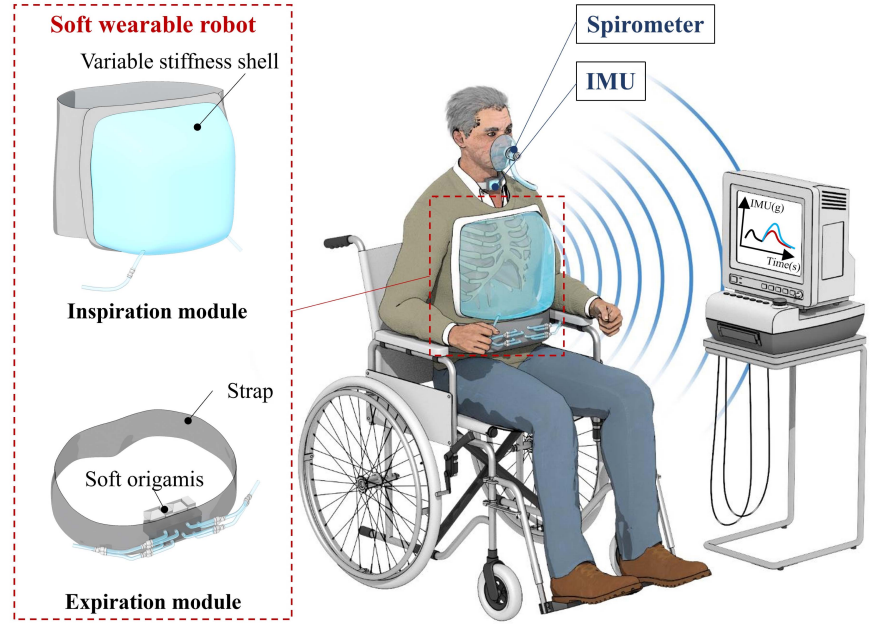
Three types of respiratory assist robotic devices were developed, and their efficacy was validated in five categories of patients with typical respiratory disorders (motor neuron injury, chronic obstructive pulmonary disease, cervical spinal cord injury, stroke, and traumatic respiratory failure). This research provides a hardware foundation and clinical experience for personalized optimization strategies involving human-in-the-loop for patients with various respiratory diseases.
Professor Roche Ellen from the Department of Mechanical Engineering and Medical Engineering at MIT commented that the cardiopulmonary function assistive technology based on soft robots is promising to overcome the limitations of traditional ventilators.
To address the issue that clinical positive pressure ventilators do not fully align with physiological breathing mechanisms and are prone to causing lung injuries and alveolar collapse, we proposed a soft wearable robotic device that simulates human physiological breathing.
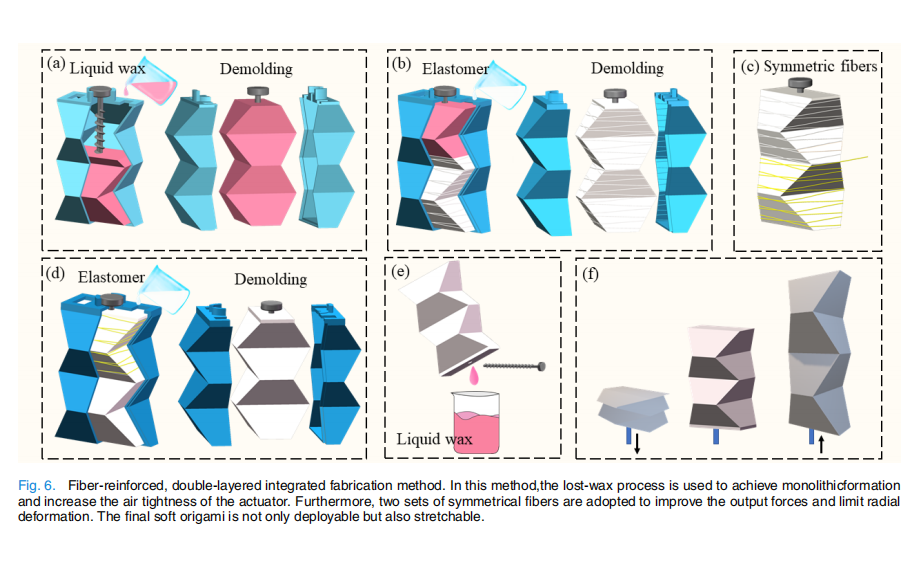
We achieved a breakthrough in fiber-reinforced double-layer casting technology and developed a high-output-force, high-folding-ratio soft actuator based on the Yoshimura tubular origami structure of Broussonetia papyrifera for expiratory assistance. The designed personalized portable exoskeleton system can effectively provide respiratory assistance to wearers in daily life scenarios and support the exploration of exoskeleton-assisted strategies during routine movements.
The research team conducted preliminary studies on key technologies of respiratory assist devices, designing a variable-stiffness negative-pressure shell based on the layer-blocking variable-stiffness actuation principle, which can switch between rigid and soft states.
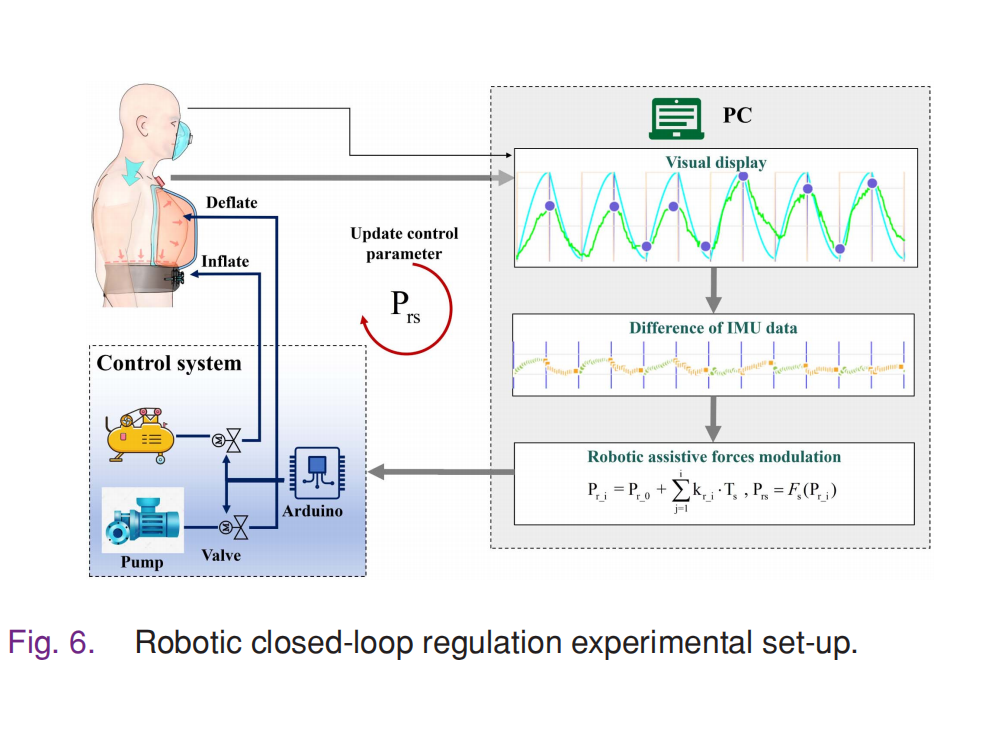
By integrating a dual-chamber respiratory mechanics model with backstepping control, a biphasic control strategy for respiratory assist devices was proposed, enabling precise regulation of lung volume. Through flexible force tactile sensors and human-device interactive force compliance control, patient-ventilator asynchrony was effectively reduced. The previously developed exoskeleton testing platform allows rapid configuration of assistive modes and has high-precision control performance, providing technical support for real-time performance optimization and assistive mode efficacy evaluation of closed-loop exoskeleton systems.
A closed-loop control system for respiratory assist devices was established, and a model-based proportional controller was designed to achieve personalized parameter adjustment and closed-loop tracking of complex breathing signals.
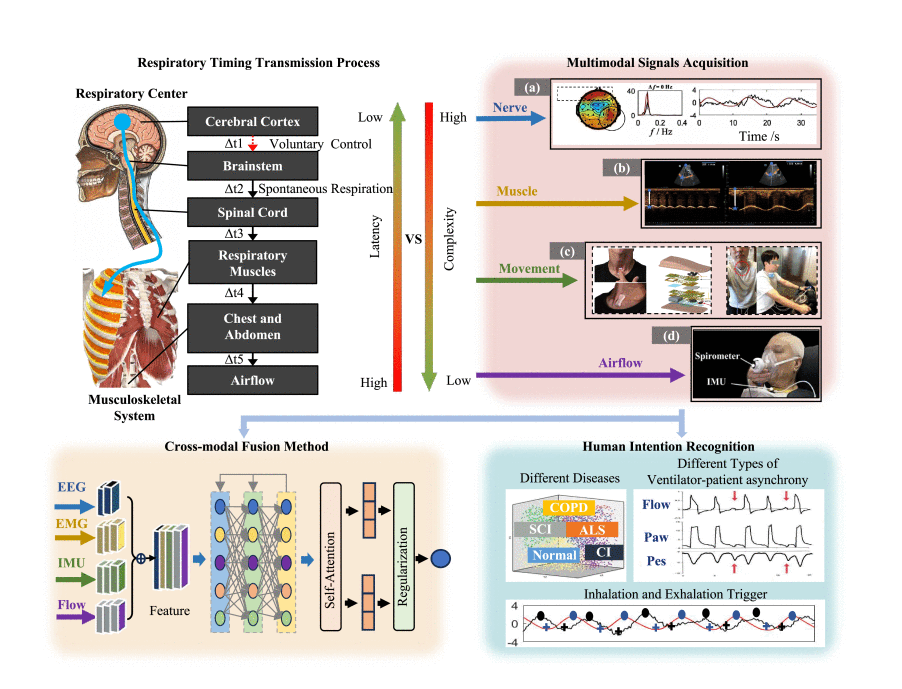
An IMU-based motion artifact removal method and a dynamic respiratory feature recognition algorithm were developed, achieving millisecond-level respiratory status monitoring and patient-ventilator synchrony triggering. Using diaphragm ultrasound for noninvasive monitoring of deep respiratory muscles, results showed that machine-assisted intervention significantly improved diaphragm mobility.These findings provide a solid foundation for personalized respiratory profiling, respiratory status assessment, and real-time clinical efficacy evaluation across diverse diseases and individuals.
A multimodal intention decoding framework was proposed based on the respiratory nerve-muscle-skeleton-airflow conduction mechanism.
Principal Investigator
- Human-Machine Integrated Cardiopulmonary Assistive Wearable Robot
Source: National Key R&D Program of China, Key Project on "Intelligent Robotics"
Duration: Jan 2025 – Dec 2027
Role: Key Participant - Bio-Inspired Cough Mechanism-Based Assistive Expectorating Soft Exoskeleton Robot
Source: General Program of the National Natural Science Foundation of China (NSFC)
Duration: Jan 2022 – Dec 2025
Role: Key Participant - Research on Respiratory Enhancement Training Technology Based on Thoraco-Abdominal Pressure-Assisted Regulation
Source: [Blinded] Project
Duration: Jun 2023 – Jun 2025
Role: Key Participant - Neural Decoding and Adaptive Control Mechanism of Voluntary Respiratory Engagement in VR Environments
Source: Independent Project of the State Key Laboratory of Virtual Reality Technology and Systems
Duration: Jan 2022 – Dec 2023
Role: Key Participant - Tactile Feedback Glove
Source: Huawei Collaborative Project
Duration: Jan 2021 – Dec 2021
Role: Participant
Published Essays
- Yan Zhang, Xue Dinghao, Zhang B, Shi Mai, Nan Xiaolu, Zhang Yuru, Ge Qinggang, Zhang Zongyu, Wang Yuxing, Feng Yanggang and Wang Dangxiao. A systematic review of soft respiratory exoskeletons: assistance mechanisms, system architectures, and key technologies in IEEE Transactions on Neural Systems and Rehabilitation Engineering, 2026, 34:1869-1884.
- Yan Zhang, Qinggang Ge, Zongyu Wang, Yuxing Qin, Yixing Wu, Mingjing Wang, Mai Shi, Lei Xue, Weidong Guo, Yuru Zhang, Guangyu Wang, and Dangxiao Wang. Extracorporeal closed-loop respiratory regulation for patients with respiratory difficulty using a soft bionic robot in IEEE Transactions on Biomedical Engineering, 2024. (SCI, Q1, IF: 4.6)
- Yan Zhang, Danye Li, Fengyao Zhang, Zongyu Wang, Lei Xue, Xiaolu Nan, Nianming Li, Xilai Tan, Weidong Guo, Yuru Zhang, Hongmei Zhao, Qinggang Ge, Dangxiao Wang. Evaluation and modeling of diaphragm displacement using ultrasound imaging for wearable respiratory assistive robot in Frontiers in Bioengineering and Biotechnology. (SCI, Q1, IF: 4.3)
- Yan Zhang, Ziqi Wang, Qinggang Ge, Zongyu Wang, Xiangjie Zhou, Shaohang Han, Yuru Zhang, Dangxiao Wang. Soft exoskeleton mimics human cough for assisting the expectoration capability of SCI patients in IEEE Transactions on Neural Systems and Rehabilitation Engineering, 2022. (SCI, Q1, IF: 4.9, Co-first Author)
- Wenzhuo Zhi, Wei Zhao, Yan Zhang, Enming Shi, Yangfan Zhou, Bi Zhang. Thoraco-abdominal biomechanical model and dual-layer control method for soft robotic system with application to respiratory assistance in Frontiers in Bioengineering and Biotechnology. (Corresponding Author, SCI, Q1, IF: 4.3)
- Yue Wang, Yan Zhang, Qinggang Ge, Yaoxi Zhang, Zongyu Wang, Weidong Guo, Yuru Zhang, Yuhui Wang, and Dangxiao Wang. Voluntary respiration control: signature analysis by EEG in IEEE Transactions on Neural Systems and Rehabilitation Engineering, 2023. (SCI, Q1, IF: 4.9)
- Zemin Wang, Yan Zhang, Dongjie Zhao, Ruibo He, Yuru Zhang, and Dangxiao Wang. Perceptually inspired C0-continuity haptic shape display with trichamber soft actuators in Soft Robotics, 2023. (SCI, Q1, IF: 6.4)
- Xilai Tan, Yan Zhang, Bin Zhao, Xiaolu Nan, Yuru Zhang, and Dangxiao Wang. A vibrotactile belt for interpersonal synchronization of breath in 6th International Conference AsiaHaptics 2024, 2024. (Conference Paper)
- Ziqi Wang, Xiangjie Zhou, Zejian Zhou, Yan Zhang, Yuru Zhang, and Dangxiao Wang. MateJam: Multi-material teeth-clutching layer jamming actuation for soft haptic glove in IEEE Transactions on Haptics, 2023. (SCI, Q2, IF: 2.4)
- Yan Zhang, Li H, Qin X, et al. Analysis of vibration response and machining quality of hybrid robot based UD-CFRP trimming in Proceedings of the Institution of Mechanical Engineers, Part B: Journal of Engineering Manufacture, 2021, 235(6-7): 974-986. (First Author)
Collaborators
Faculty
Doctor
News
- 2026-05-26: Our wearable variable-stiffness textile with three-dimensional bistable structures based on bionic respiratory sensing won the Second Prize in the Fengru Cup Competition of Beihang University. Congratulations to Zhao Yingheng and other students.
- 2022: Our respiratory assistive robot technology was included in the China Rehabilitation Medicine Report 2022 as the only selected technology in the respiratory assistive robot category.